Download a PDF version to print or share.
United States Secretary of Commerce Howard Lutnick has proposed imposing a 50% innovation tax on revenues universities earn from licensing their discoveries to the private sector. This proposal would significantly undermine the legislative intent of the Bayh-Dole Act, a bipartisan law that ensures taxpayer-funded inventions benefit the public rather than languishing in the lab. We urge Congress to reject an innovation tax on university licensing revenue because it threatens America’s ability to innovate, compete, and grow our economy.
The Trump administration has proposed imposing a 50% tax on revenues universities earn from licensing their discoveries to the private sector. This proposal would significantly undermine the legislative intent of the Bayh-Dole Act, a bipartisan law that ensures taxpayer-funded inventions benefit the public rather than languishing in the lab. We urge Congress to reject a tax on university licensing revenue because it threatens America’s ability to innovate, compete, and grow our economy.
Taxing licensing revenue will weaken innovation and chill investment
America’s innovation pipeline depends heavily on university research. For this pipeline to function effectively, all participants – scientists, investors, manufacturers, and consumers – must be protected against policies that significantly increase risks and costs.
- In a recent survey, all members of the Bayh-Dole Coalition said a tax on licensing revenue will generate less federal revenue than the current system.
- Members of the coalition include Conservatives for Property Rights, National Association of Manufacturers, and advocates for intellectual property, entrepreneurship, and free enterprise.
- Secretary Lutnick’s proposal represents gross federal overreach on the intellectual property rights and licensing capabilities of universities and their private sector partners.
- A tax on licensing revenues injects friction and uncertainty into the U.S. patent system, discouraging venture capitalists from investing in startups spun off from university research.
- University-industry partnerships, incubators, and workforce development programs will be unsustainable.
- Secretary Lutnick's proposal will effectively choke the innovation pipeline, leaving discoveries that save lives and make us more productive locked in labs.
Bayh-Dole brings federally funded discoveries to the marketplace
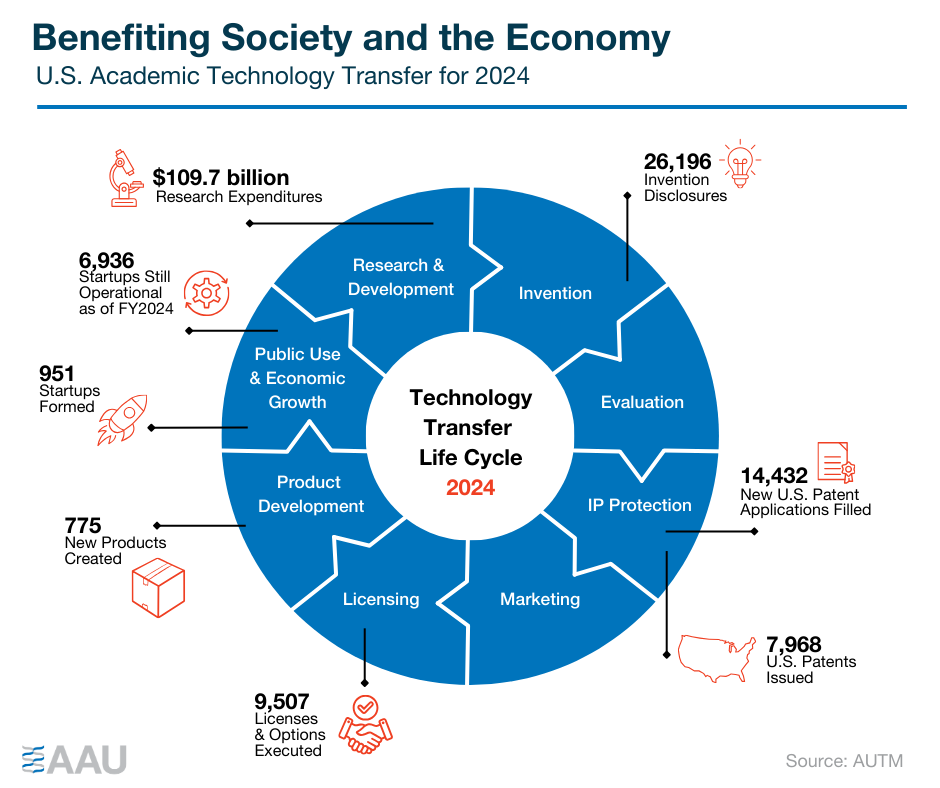
Since its passage in 1980, Bayh-Dole has been a key driver of American innovation and economic growth by facilitating technology transfer from university labs to businesses. From 1996 until 2020, technology transfer resulted in 580,000 inventions, nearly 150,000 U.S. patents, more than 19,000 startups, and support for 6.5 million jobs.
- Entrepreneurs take patented discoveries and, through intensive research and development (R&D), transform them into products and applications for everyday use.
- These products include hundreds of medicines, technologies, and tools that save lives, enhance productivity, and improve human health. Examples include internet search, cancer screenings, HIV therapies, air quality monitoring sensors, and mRNA vaccines.
- Technology transfer made possible by Bayh-Dole has delivered prosperity: tens of thousands of startups and small businesses, millions of jobs, and $1 trillion in gross domestic product (GDP) over three decades.
Taxpayers are the primary beneficiaries of university licensing revenue
Universities don’t profit from technology transfer and licensing patents. By law, all licensing revenues must be reinvested into research, training the next generation of scientists, and covering tech transfer costs.
- Taxpayers already benefit from licensing revenues through both advancements that make us healthier, safer, and more productive and future local, state, and federal taxes generated by Bayh-Dole-related economic activity: jobs created; startups launched; and products developed, marketed, and sold.
- Most university patents do not generate significant revenue. However, an innovation tax on licensing revenue would take an outsized toll on efforts to train the next generation of scientists, support research, and discover the next big breakthrough.
Bayh-Dole powers state and regional ecosystems
In America’s heartland, research universities anchor strong innovation ecosystems made possible by Bayh-Dole and technology transfer.
- Among the nearly 500 startups launched from university research, 68% remained within 60 miles of their founding university, according to a recent study.
Bayh-Dole helps America remain the global leader in life sciences
Bayh-Dole leverages massive public investment in basic biomedical research by creating a pathway for commercialization from university labs to clinical trials to hospitals, clinics, and pharmacies.
- The United States develops more new medicines than any other nation because Bayh-Dole enables companies to license patented molecules from universities and turn them into novel drugs and therapies.
- In the 1980s, less than 10% of new drugs were first introduced in the United States; by the 2010s, that share had grown to more than 60%.
- Since 1980, more than 200 drugs and vaccines have been developed through public-private partnerships.
Bayh-Dole already contains strong government oversight provisions
By law, universities are required to report all inventions to the federal agency that funded the research.
- Universities are required to make “active efforts” to commercialize their inventions through patent-licensing agreements with private companies.
- Small businesses and domestic manufacturers must be given preference.
- The government can only exercise “march-in” authority in a narrow set of circumstances, such as when companies fail to make or distribute products developed from federally funded research.
- The government has never exercised march-in rights since Bayh-Dole’s passage.