Find all Leading Research Universities Reports below. The Leading Research Universities report is a free newsletter covering events in higher education and research.

A recent analysis by Nature magazine “shows that the Trump administration has terminated more than 100 advisory committees to science agencies — and reduced the transparency and independence of those that remain.” The reporting underscores why Americans should be concerned not only about the recent dismissal of all 22 members of the National Science Board (NSB), but more broadly about the amount, quality, and transparency of the advice that federal science agencies are receiving from experts outside the government.

Since its launch in 2016, NASA’s University Leadership Initiative has educated more than 1,100 students at 100 universities through large-scale, multiyear research projects that advance NASA’s aviation priorities. The anniversary arrives at a critical moment for NASA’s research and education programs.

The new caps will make it significantly harder for Americans to attend law school and medical school or to obtain training for professions, including nursing, that require advanced education.
While the House’s proposed cuts are less extensive than those proposed by the president in his FY27 budget request, if enacted, the House bill would inflict serious harm on the American scientific research enterprise.
The recent news that President Trump notified all 22 members of the National Science Board that they were being dismissed, effective immediately, has caused alarm in the scientific community because of the body’s unique role in leading the National Science Foundation – one of the world’s premiere research-funding agencies.
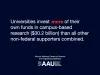
While much of university research has been funded by the federal government, most Americans don’t realize that universities are not just recipients of federal support. Universities already provide more to fund their own research than private businesses, charitable foundations, or state governments – meaning they have little capacity to backfill significant cuts to federal research funding from other sources.

Reporting from The New York Times and The Washington Post confirms AAU’s recent analysis showing that the rate of competitive awards made by NIH has slowed down significantly this fiscal year.
Across the country, NASA funds research projects on university campuses that are developing new technologies for robotic exploration, advancing our understanding of the universe, yielding useful knowledge of our planet and solar system, and training the next generation of scientists and engineers. On April 21, a showcase, “Igniting Discovery: How NASA Funding Advances American Science,” exhibited some of that research on Capitol Hill.

Though NASA’s astronauts are back on Earth following the completion of the Artemis II mission, the scientific impact of their historic trip around the moon will continue to reverberate for years to come – and research from AAU member universities is partially responsible for the success of the program that launched it.

A new report warns that the loss of talent will hurt long-term economic growth and innovation in the United States, including in areas such as artificial intelligence, quantum computing, biotechnology, and advanced manufacturing.