
By Kritika Agarwal
The Department of Energy has launched a national initiative to double the pace of scientific discovery in the next decade. The Genesis Mission – the result of a November executive order by President Trump – seeks to harness the power of artificial intelligence to “empower researchers to solve the hardest scientific challenges” currently facing the nation.
That ambition set the stage for a recent DOE summit that brought together university and science philanthropy leaders to begin developing a vision for success for the Genesis Mission and its academic partners. The summit underscored the indispensable role that research universities play as hubs for cutting-edge AI research and for developing the future workforce.
Pushing the Frontiers of Science
In a November letter to the research community, DOE Under Secretary of Science Darío Gil called the Genesis Mission “a historic national effort reminiscent of the Manhattan Project and the Apollo programs.”
Specifically, the initiative seeks to create “a national discovery platform that unites the world’s most powerful supercomputers, AI systems, and emerging quantum technologies with the nation’s most advanced scientific instruments.” According to Gil, “When realized, it will be the most complex and powerful scientific instrument ever built” that will push the frontiers of science.
The department recently announced a portfolio of “grand challenges” that the Genesis Mission will seek to address. The challenges, which range from “securing America’s critical minerals supply” to “delivering nuclear energy that is faster, safer, and cheaper,” were selected for their potential “to deliver measurable benefits for the American people,” according to DOE.
Universities as Indispensable Partners
At the DOE-sponsored Genesis summit on February 18, three AAU university presidents participated in a panel discussion on the role of universities in advancing science through AI and strengthening STEM education and AI literacy. “When I think about what the role of the university is in advancing science through AI, there’s three dimensions: one is the research dimension, the second is the education dimension – training the next generation of workforce… – and the third is in partnerships,” said Stony Brook University President Andrea Goldsmith.
“AI is poised to significantly accelerate scientific discovery, not just by improving efficiency but really by completely transforming the scientific discovery process,” said Carnegie Mellon University President Farnam Jahanian. He noted that AI is particularly useful in simulating and predicting how complex systems (such as the human body, the climate, energy grids, supply chains and more) behave, as well as in sifting through enormous datasets to find patterns and relationships that are impossible to achieve at human scale.
As an example, Jahanian highlighted research at CMU that used computational simulations and machine learning techniques to identify a new aluminum alloy that is capable of withstanding extremely high temperatures and that could have applications in the automotive and aviation industries while delivering significant cost savings.
Universities are also playing a particularly crucial role in bringing together scientists and AI experts to solve complex problems and in building durable collaborations with industry. Goldsmith, for example, talked about the AI Innovation Institute at Stony Brook, which brings together faculty from different disciplines, students, and AI experts to advance scientific research. And Purdue University President Mung Chiang discussed his university’s recent partnership with Google to “advance AI-enabled education, accelerate AI innovation and expand AI workforce development” and with Eli Lilly “to accelerate innovation at every stage of the pharmaceutical pipeline.”
Universities are also essential in training the future workforce – not just scientists and researchers, but also the students who will get jobs in other fields and will need to know how to effectively use AI.
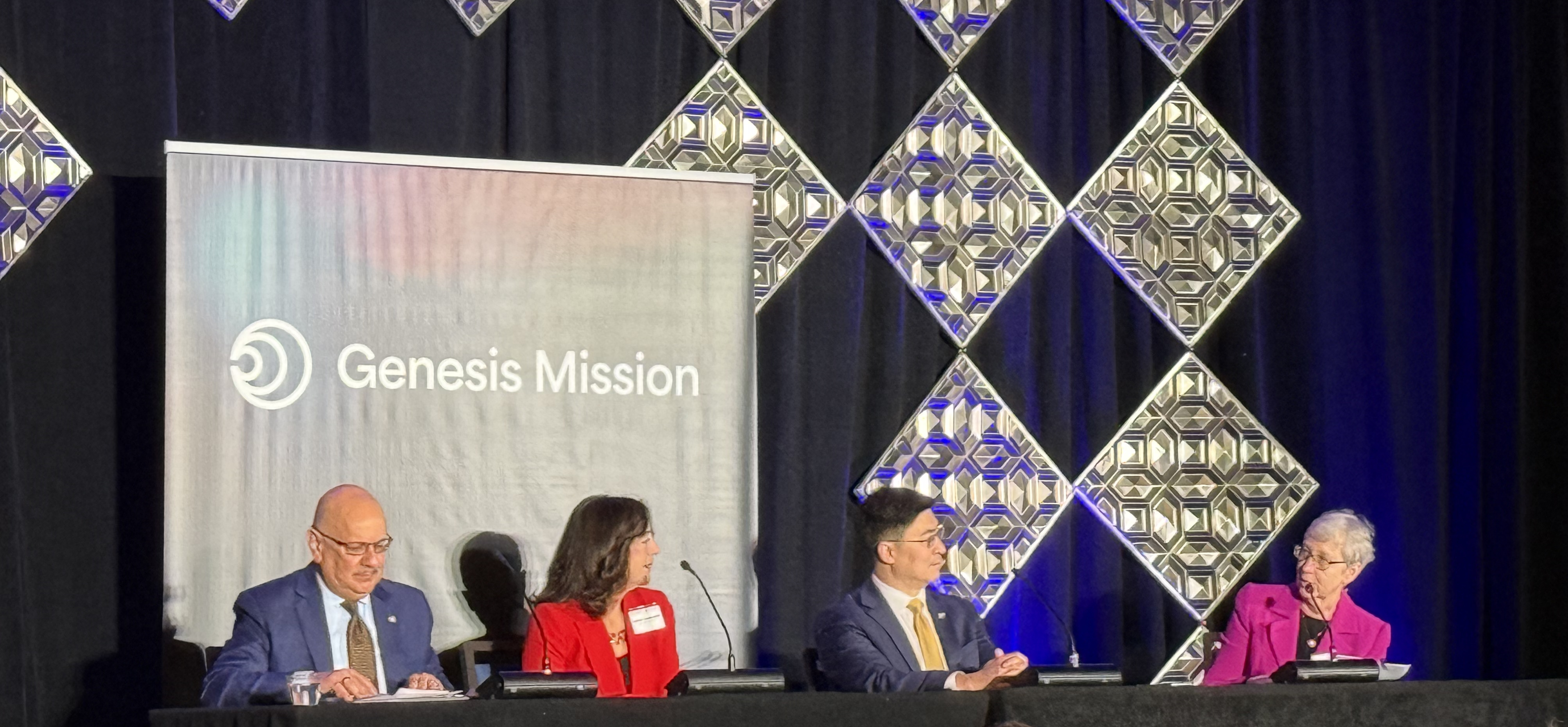
“On the education front … AI has to be something that every one of our students knows how to use as a tool and not a crutch,” said Goldsmith. Chiang noted that Purdue recently implemented an “AI working competency” requirement for all of its undergraduate students so they are better prepared for the workforce and to use AI.
The presidents also discussed how universities are rethinking graduate and doctoral education to meet industry needs in STEM and AI while providing clear value for students. “We are not going to win the AI and science race if we don’t win the race for talent. It has to be done,” said Jahanian.
Ultimately, Jahanian argued that universities must ensure that “the science and engineering research that we’re doing is not only serving humanity, but it serves the competitive advantage, the economic advantage that we have in this country, and also protects our national security.”
Jahanian noted that collaborations between universities, DOE’s national labs, and industry will be critical “to accelerate not only scientific discovery but bringing that to reality and having real impact on our economy, [and] on society.”
The session was moderated by Kathy Yelick, vice chancellor for research at the University of California, Berkeley. A video recording of the session is available on YouTube (the panel begins at approximately the 1:16:00 mark):
Next Steps
After the presidents’ panel, summit participants (including university administrators and researchers, national labs personnel, and DOE officials) broke into small groups to brainstorm and discuss topics such as institutional partnership innovations, lighthouse challenges, computing and data ecosystems, workforce development and engagement, and research productivity.
DOE said that it will use the feedback collected during the breakouts to inform next steps and policy actions to realize its goals for the Genesis Mission.
In addition to hosting the summit, the department has been engaged in a flurry of activity to get the Genesis Mission off the ground. Earlier this month, DOE announced the formation of the Genesis Mission Consortium to help build and strengthen collaboration between the department and external stakeholders, including private sector and university leaders, to advance the initiative.
DOE also recently entered into multiple agreements to build AI supercomputers at three of its national laboratories. These supercomputers will form part of the Genesis computational backbone.
Kritika Agarwal is assistant vice president for communications at AAU.