
By Kritika Agarwal
America’s innovation pipeline depends heavily on university research. Every year, researchers make discoveries in university labs that lead to new products and new startups that bring those products to market – creating thousands of jobs and even entire new industries.
In fact, in 2025 alone (according to AUTM), university research led to the creation of 761 new products, 1,095 new startups, and 13,729 applications to patent new discoveries. These numbers show how deeply woven university research is into the nation’s innovation economy – and how important university technology transfer is to turning ideas into innovations and industries.
From Discovery to Impact
When university researchers discover something new – a medical device, a new diagnostic test, a novel material, or a new chemical process – they work with a campus technology transfer office to secure patents for their discoveries. They then either partner with existing companies or launch startups to turn their discoveries into products.
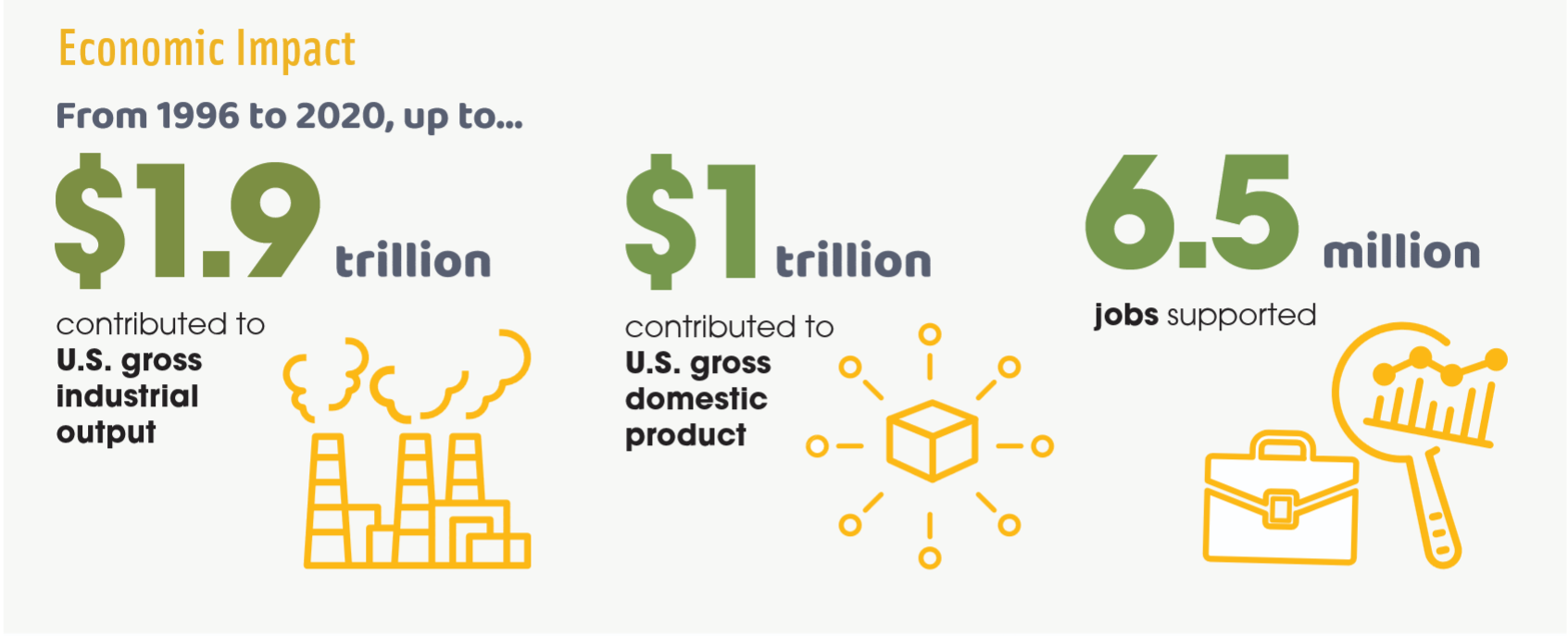
This process, known as “tech transfer,” helps turn academic discoveries into new companies, new jobs, and new products that improve lives and provide a return on taxpayers’ investment in university research. AUTM’s latest data show that, between 1996 and 2020, academic tech transfer contributed $1 trillion to the United States’ GDP and supported 6.5 million jobs.
Credit: AUTM
University Research in Action
University tech transfer offices around the country are hard at work every day to bring new research to market. Some recent examples of successful startups include:
- University of Michigan researcher Zhong He developed novel radiation detectors for use in diverse settings. His semiconductor gamma-ray detector led to the launch of H3D, a startup based in Ann Arbor, MI, with revenue exceeding $90 million. Sensors produced by H3D are used in 75% of nuclear power plants in the United States as well as plants around the world. He later launched M3D, where he created RAVIN, a camera that monitors radiation levels in medical settings. Made possible by NIH funding for research into proton cancer therapy, the device is now used by more than 25 hospitals.
- Massachusetts Institute of Technology-based startup CoFlo developed a patented device that allows healthcare providers to inject highly viscous biologic drugs into patients subcutaneously (i.e. directly below the skin), rather than via the hours-long infusions these treatments often require. By cutting the time required to administer the drugs to seconds, the device increases access to treatment for patients with cancer and autoimmune diseases and lowers costs.
- Roughly one out of four stroke victims experiences a second stroke. CaroRhythm, a startup out of New York University, is developing a non-invasive wearable device that alerts patients who have already had a stroke and their doctors about the risk of another stroke before symptoms appear. The startup emerged out of NYU’s Clinical Biophotonics Laboratory and is part of the NSF I-Corps program, illustrating how federal programs and university entrepreneurship training help turn lab discoveries into lifesaving tools.
- Trace AQ, a University of Utah startup, developed an app that provides earlier and more accurate local air quality forecasts using physics-based models. The app, Flow AQ, was designed with Utah’s many outdoor athletes in mind and helps users better plan for unhealthy air quality events. The research behind Flow AQ was funded by the National Science Foundation, and Trace AQ raised $1.25 million during its seed round.
As AUTM’s latest data show, university research has given rise to thousands of startups in the last three decades. And, over the years, tech transfer from universities has resulted in technologies such as Doppler weather radars, MRI machines, time-release capsules, touchscreens, and more – innovations that millions of people use every day.
A New Initiative to Accelerate Commercialization
As is evident from AUTM’s data, research universities play a central role in translating discoveries into patents and entrepreneurship – and, ultimately, contributing to long‑term U.S. competitiveness. This is why AAU recently joined a coalition, led by the National Academy of Inventors and the U.S. Patent and Trademark Office, that is launching a new five-year national initiative designed to bring together universities, industry, government, and other innovation organizations to accelerate discovery into societal impact and economic benefit. The initiative will “strengthen America’s invention-to-impact pipeline by uniting research, intellectual property, entrepreneurship, technology transfer, commercialization, and workforce development through a coordinated national strategy.”
As AUTM has documented, university-driven discoveries have already led to new products, startups, and patents. This new initiative will help ensure that even more campus-born discoveries will make the journey from the lab to the marketplace.
Kritika Agarwal is assistant vice president for communications at AAU.