
By Kritika Agarwal
Disruptions to American science are causing young scientists and researchers to rethink their future in academia or even whether they wish to stay in the United States, according to a new National Bureau of Economic Research study. This shift in career intentions, the study’s authors say, is an early warning that the U.S. STEM talent pipeline – which feeds both academic and industrial research and development – is cracking.
What the Researchers Found
In March 2025, Pierre Azoulay (Massachusetts Institute of Technology), Raffaella Sadun (Harvard University), and Daniels Scur (Cornell University) asked 916 PhD students and postdocs across 770 biomedical labs at 134 U.S. institutions three simple questions: How likely are you to stay in academia? How likely are you to stay in the United States? How satisfied are you with having pursued a PhD in science?
The researchers asked the scientists to respond to the questions twice: how they felt at the time of the survey, and how they felt six months prior — before the new administration had begun a series of actions that significantly disrupted the U.S. scientific enterprise.[i]
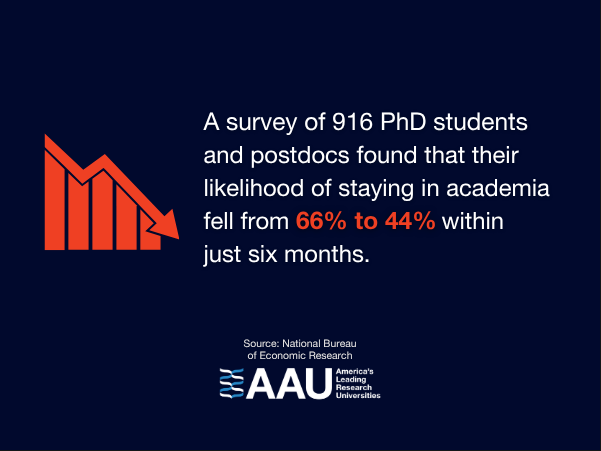
The change in sentiment that the researchers found was striking:
- The share of young scientists who said they were likely to stay in academia fell from 66% to 44% over that six-month period.
- The share of respondents likely or very likely to remain in the United States fell from 93% to 72% in the same period. The decline was larger for foreign students and researchers than for domestic students. This matters because nearly half of all STEM doctoral degrees in the United States are awarded to foreign-born students. The largest declines in intention to remain in the United States were among trainees from Europe, followed by Indians and Latin Americans.
- Satisfaction with having pursued a PhD also dropped; while 92% of respondents reported being satisfied or neutral six months earlier, only 76% did so at the time of the survey.
Reasons Behind Shifting Career Outlooks
Many of the administration actions that disrupted the American scientific research enterprise happened quickly after the new administration took office in January of 2025.
For example, just days after inauguration, the White House Office of Management and Budget issued a memo that froze nearly all federal grants and loans. (The memo was later rescinded.) President Trump issued several other early executive orders that caused federal agencies to review and retroactively cancel research grants to ensure compliance. Federal science agencies also began laying off staff, cutting off millions of dollars in federal grants to particular universities, and capping indirect cost rates on research grants. The cumulative effect of these and other measures was to inject significant ongoing uncertainty about the future of federal science funding, which both PhD students and postdocs rely upon for their research.
Meanwhile, Trump also issued an executive order requiring federal agencies to increase the screening and vetting of students seeking to come to the United States and the State Department abruptly began revoking international student visas.
The authors of the NBER study draw a link between this climate of instability to the increasing pessimism among young scientists. “At minimum, … [the data] indicate that the current policy environment is generating substantial uncertainty and dissatisfaction among precisely the people the scientific enterprise needs to attract and retain,” they write.
What the Data Mean
The new study’s researchers argue that “[y]oung scientists are a canary in the coal mine of the American scientific enterprise.” They “have the most career flexibility” and the “least sunk cost in the current system,” making it easier for them to pivot to other options. If they follow up on their intentions to leave academia or to leave the country, the authors say, the United States risks immense damage to its scientific innovation system, both public and private.
Writing in Harvard Business Review, the study’s authors note that the PhD students and postdocs “who are reconsidering an academic career today are the same people that R&D leaders [in private industries] are expecting to hire in two to five years – the bench scientists, the computational biologists, the machine-learning researchers.”
Furthermore, “Decades of research in economics has documented that public and academic R&D spills over into private-sector productivity – through patents, trained researchers who move to industry, informal collaborations, and proximity effects,” they write, adding: “When the academic system produces fewer trainees, fewer ideas, and fewer star scientists, innovation and productivity are likely to drop in the private sector too.”
Already, we have seen how uncertainties in federal funding have led to a 15% decline in doctoral admissions at major research universities in the United States. Meanwhile, U.S. issuance of visas to international students fell by a third in 2025.
If the students and researchers – both domestic and international – who are already at our universities also leave, the effects on the U.S. scientific enterprise and the economy would be immense. Losing even a fraction of a generation of PhD students and postdocs would weaken both American universities and the innovation economy they fuel – damage that would take decades to repair, if it can be repaired at all.
[i] The researchers verified the accuracy of recall responses by comparing them to responses given by a quarter of respondents who also participated in phone interviews before the end of 2024.
Kritika Agarwal is assistant vice president for communications at AAU.