
By Emily Miller and Tobin Smith
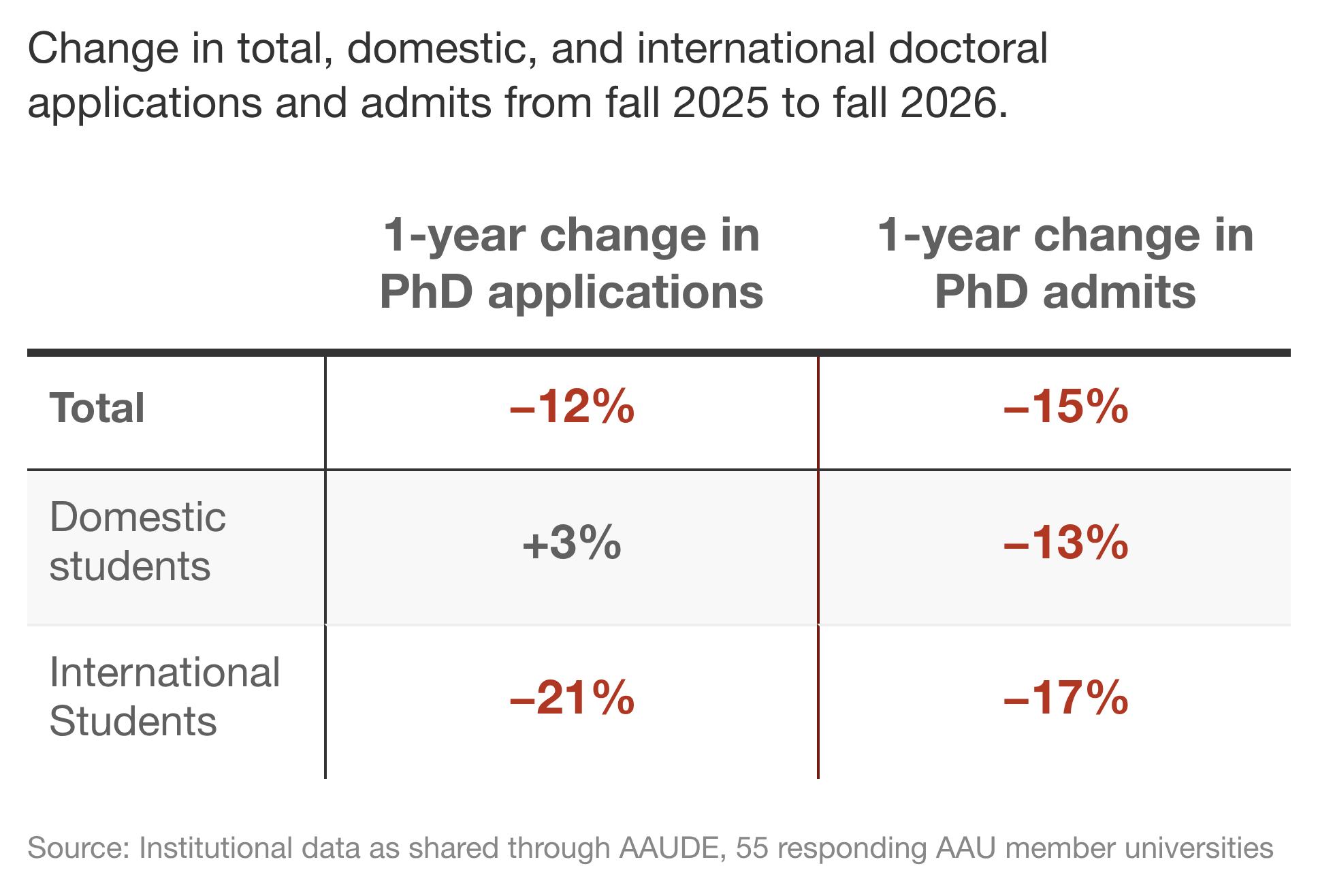
New data show that major research universities across the nation accepted 15% fewer applicants to doctoral programs for fall 2026 compared to fall 2025. This marks the second consecutive year in which the data have shown a substantial reduction in the number of new PhD students at major research universities.
This trend should concern everyone, not just higher education leaders. Why? Because a shrinking doctoral pipeline, especially in STEM fields, means a thinner bench of innovators, fewer future scientific and medical breakthroughs, and a diminished capacity for the United States to compete against China and other nations in an increasingly knowledge-driven global economy.
The admissions data, collected by the Association of American Universities Data Exchange (AAUDE) from 55 AAU member institutions, show that the number of doctoral admissions – a measure of universities’ ability to enroll new PhD students – declined 15% overall in fall 2026 compared to last year.
The data also show that, while domestic students submitted a higher number of applications (+3%) to doctoral programs, international student applications to PhD programs declined by 21%. This points to a substantial reduction in demand among international students for pursuing research doctoral degrees at U.S. universities.
However, despite the increasing demand for doctoral education from domestic students, the data show that universities’ capacity to support that demand has diminished, leading to cuts in admissions for domestic students as well.
How Federal Funding Uncertainty Is Constricting Doctoral Education
Cuts in graduate admissions can be linked directly to the financial uncertainties universities are facing as a result of declining and unpredictable federal research funding.
The U.S. doctoral education system is built around an apprenticeship model in which students work alongside faculty conducting original research while developing the skills needed to become independent scientists and scholars. In fact, doctoral students make crucial contributions to cutting-edge university research aimed at finding new cures, saving lives, developing new technologies, supporting local farmers, and protecting national security.
Since World War II, the United States has relied on a partnership between the federal government and research universities to fund doctoral education. Under this model, federal research grants to universities support both scientific discovery and the training of the next generation of U.S. scientists and engineers. For decades, this dual investment in research and talent development has been a cornerstone of America’s scientific leadership. Today, this model is increasingly under strain.
Since the beginning of last year, federal research agencies such as the National Institutes of Health and the National Science Foundation have been terminating previously awarded grants, facing proposals from the current administration for major cuts to their budgets, and slowing the pace of new awards despite receiving adequate congressional appropriations.
Agencies have also been implementing additional requirements for grant proposals to be reviewed by political appointees, further delaying funding decisions and creating widespread uncertainties about whether certain projects will receive federal funding. As a result, many universities have become more cautious about making long-term commitments to new doctoral students in STEM, whose ability to pursue their education depends heavily on research grants.
Meanwhile, changes in U.S. immigration policy have made international students feel less welcome and universities in other countries have also stepped up their efforts to recruit international STEM talent. The combined shift may well have reduced international student interest in pursuing doctoral education in the United States.
Why Fewer PhDs Matter: The Consequences for Innovation, Economic Growth, and National Security
For universities, doctoral education is a long-term financial commitment. However, without a predictable stream of federal research funding, universities cannot know exactly how many graduate students they can successfully support through completion of their PhD programs.
The possibility that grants could be terminated mid-stream for political reasons, or that the research budgets for agencies such as the NSF could be cut by more than 50%, makes it harder for universities (and the sub-units of universities, where admissions decisions are often made) to know whether they will be able to support new doctoral students for the next five to six years – the average length of most PhDs.
In fact, some universities are now requiring academic departments to only admit new PhD students if the departments know they have adequate federal research support or support from other sources.
The Damage Is Already Visible
The result is a broad contraction in doctoral training capacity at research universities. Indeed, many universities have gone so far as to pause doctoral admissions entirely and have turned away highly qualified applicants, including in fields of critical national importance such as AI, quantum computing, and advanced engineering.
The disruption also extends to students far along on the pathway to receiving their doctorate. PhD students whose research has been derailed by abrupt grant terminations and stalled renewals have been forced to abandon their original thesis work, find new faculty advisors, and, in some cases, delay their degree completion by more than a year. This, in turn, has had a further cascading effect – current students, often supported by bridge funding provided by universities, are occupying spots that would otherwise have gone to newly admitted doctoral students, further constricting the pipeline.
Doctoral students and early-career researchers applying for their first research grants are also being shut out and are not receiving awards, even when their proposals have been rated highly on scientific merit. At the same time, staffing shortages and administrative delays at federal agencies have made it difficult for all researchers to obtain information regarding pending grant applications and funding decisions. This is alarming – and particularly in STEM, as the funding uncertainty comes at a time when there is growing international competition for top rising and established scientific and engineering talent.
The impact extends well beyond graduate education. Federal grants fund both PhD students and undergraduate learning assistants to deliver evidence-based undergraduate teaching, (particularly in STEM fields, where they help lead lab classes, discussion sections, and mentor students). Fewer funded doctoral students and learning assistants means fewer instructors available to support undergraduate learning, potentially weakening the educational experience for students who will become the nation’s future science and technology workforce.
Equally concerning, many undergraduate research programs have already experienced delays or cancellations due to funding uncertainties, reducing opportunities for undergraduates to gain hands-on research experience. These experiences are often the first step toward advanced study and research careers, making them a critical pathway into the nation’s future STEM workforce.
For example, a faculty researcher at one AAU university was informed by the National Science Foundation (the granting agency) that two pending research grant proposals to support undergraduate researchers for the spring of 2025 could not be supported due to funding constraints. The loss of that funding meant that they were unable to train nearly a dozen undergraduate research assistants in their lab and were forced to let go other full-time researchers and postdoctoral scholars who had been supported by the program.
The Risk to America of Losing a Generation of Scientific Talent
As PhD admissions decline, America faces the alarming prospect of losing an entire generation of scientific talent. When promising undergraduate students look at the uncertainty surrounding doctoral funding, research continuity, and career prospects, many will make a rational choice – taking industry jobs straight out of college or pursuing doctoral training abroad. The pipeline, once broken, will be extraordinarily difficult to rebuild.
Further, diminished PhD cohorts mean that we are not developing the future faculty members who will educate and train the scientists, engineers, and technical workforce required for the United States to compete globally against countries like China that are continuing to expand their investments in research, innovation, and scientific talent.
The loss will not be limited to domestic talent. International students and scholars, long drawn to the United States by the research quality and openness of our universities and the scientific enterprise, are increasingly looking elsewhere.
As highlighted in a recent report by Business for Federal Research Funding, other nations are taking notice of research chaos in the United States – and acting on it. They are actively crafting new policies to attract the very students and researchers that U.S. policy is driving away. This is not a passive shift; it is a competitive realignment being accelerated by what the report aptly describes as an “unforced error” on the part of the United States.
Federal investment in university research has never been solely about funding scientific projects. It has also been America’s primary investment in developing the future scientists and engineers our nation needs.
As policymakers debate the future of federal research spending, they should recognize that reductions in research support do not simply affect laboratories and grant portfolios; they also affect the nation’s ability to train the next generation of innovators whose discoveries will drive economic growth, improve health, strengthen national security, and sustain American scientific leadership in the decades ahead. A diminished doctoral pipeline translates directly into less innovation, slower medical breakthroughs, a weakened technology sector, and real vulnerabilities to our economic strength and national security.
The United States did not arrive at its position of scientific leadership by accident. It was built deliberately, over generations, through sustained investment and a commitment to attracting and training the world’s best minds. That leadership is now at risk.
Emily Miller is vice president for research and institutional policy at AAU; Tobin Smith is senior vice president for government relations and public policy at AAU.