
By Bianca Licitra
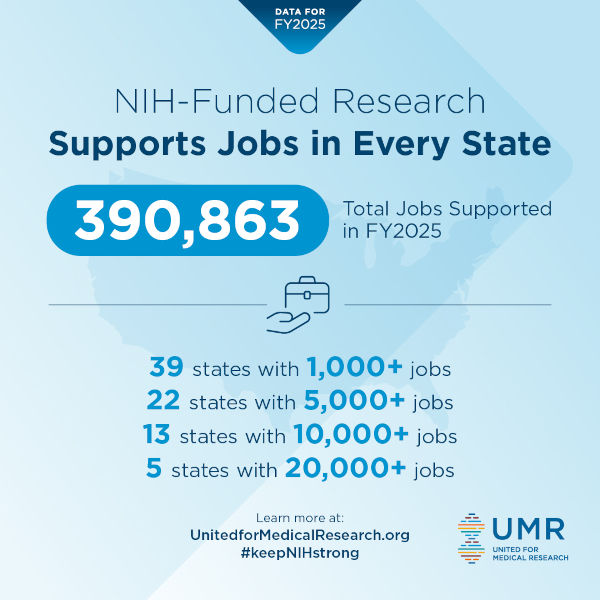
Research funding provided by the National Institutes of Health in FY25 supported 390,863 jobs and drove $94.15 billion in new economic activity nationwide, a new report by United for Medical Research (UMR) found.
The report, “NIH’s Role in Sustaining the U.S. Economy,” is an analysis released annually by UMR, an association of which AAU is a founding member.
The NIH is the federal government’s premier medical research agency and one of the largest funders of medical research in the world. More than 80% of NIH’s budget supports external, cutting-edge scientific discovery through a competitive, merit-based process that annually awards grants to more than 300,000 researchers at more than 2,500 universities, medical schools, and institutions in all 50 states. Biomedical and health research at these institutions, supported by the NIH through its 27 institutes and centers, has led to countless discoveries and innovations that have improved the lives of all Americans and enhanced the nation’s global competitiveness.
The UMR report underscores that, in addition to “fueling life-saving discoveries,” the NIH is “a proven reliable investment” for American taxpayers because its research grants create jobs and boost economic activity across the country. “For every $1 invested in NIH research, there was a 250% return,” the report emphasizes.
The report identifies this exponential return as the “research ripple effect,” noting that “[w]hen the NIH funds a research project, the impact of that funding reaches far beyond its original recipients.” Across the nation, in every state, researchers receive NIH funding that supports jobs and leads to the purchase of goods and services, further driving economic activity.
“Even amid funding disruptions last year, NIH research continued to deliver extraordinary value for patients and communities across the country,” said Caitlin Leach, UMR president. “The return on investment is undeniable – but maintaining that return requires strong and stable NIH funding.”
One challenge to stable NIH funding is the awarding of multi-year funding. Though NIH successfully spent its FY25 budget, awarding $36.58 billion in research grants, there were significant shifts in how the awards were distributed. “To meet its September 30 deadline following earlier delays, NIH made expanded use of multi-year funding – obligating the full value of certain grants upfront rather than distributing funding annually,” UMR’s press release stated.
Use of multi-year funding (also known as “forward-funding” grant awards), allowed the agency to make larger grants, albeit to an overall smaller number of grantees. As the UMR report notes, the rate of research-grant applicants who were successful in receiving an award dropped to about 17% in FY25, compared to 26% in 2024 and 30% in 2023; this makes it the lowest level in nearly 30 years. The FY26 Labor-Health and Human Services-Education bill, signed into law in February, includes restrictions on NIH’s use of the multi-year funding mechanism this fiscal year.
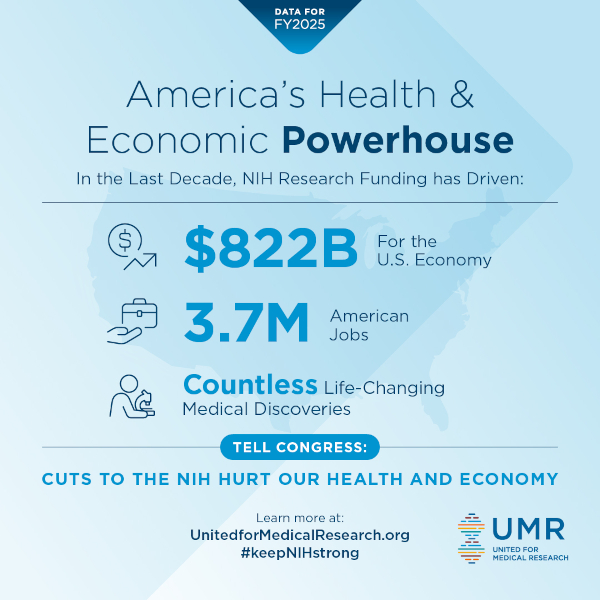
UMR’s report credits strong, bipartisan congressional support in the last decade for the continued investment in NIH research funding, without which the nation would have lost more than $822 billion in economic activity and approximately 3.7 million jobs in addition to countless life-saving innovations. Beyond that, the report notes, NIH funding produces doctors and researchers who contribute to a highly skilled workforce, strengthen national security, support critical industries, and help maintain global leadership.
AAU urges Congress to continue providing sustained and predictable investment for NIH.
Bianca Licitra is the editorial and communications assistant at AAU.