
By Ali Tyler
NASA’s headline missions (like Artemis II’s recent groundbreaking flight around the moon) may grab the spotlight, but they rest on a deep foundation of university research. Across the country, NASA funds research projects on university campuses that are developing new technologies for robotic exploration, advancing our understanding of the universe, yielding useful knowledge of our planet and solar system, and training the next generation of scientists and engineers. On April 21, a showcase, “Igniting Discovery: How NASA Funding Advances American Science,” exhibited some of that research on Capitol Hill.
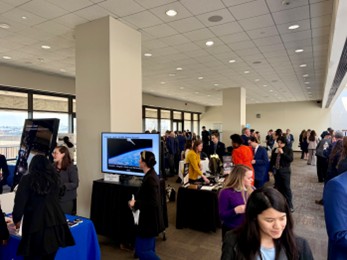
The showcase – co-hosted by AAU, the Association of Public and Land-grant Universities, the Planetary Society, the American Geophysical Union, and other associations – brought together companies, labs, and universities from across the nation to highlight the breadth of NASA-funded science and its importance in keeping America ahead in the Earth and space sciences. The showcase was sponsored by Sen. John Hickenlooper (D-CO).
Ten AAU member universities participated in the showcase. Doctoral students from the University of California, Irvine talked to congressional staff about how they are using groundbreaking instrumental and data analysis techniques to identify Earth-like exoplanets in the galaxy. NASA will use next-generation telescopes to further study the planets the students identify to search for signs of life outside of our Solar System.
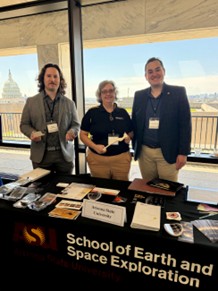
Scientists from Arizona State University also shared several of their NASA-funded projects at the showcase. The university’s School of Earth and Space Exploration does research on a range of topics from planetary origins to astrobiology. The implications of their research go beyond space; for example, results from a study on the effect of zero-gravity settings on bone mass density could lead to a possible early-detection diagnostic for osteoporosis.
Researchers at the showcase emphasized that universities are critical to training the next generation of our scientific and aerospace workforce. For example, 30 NASA astronauts got their start at Purdue University, which is now known as the “cradle of astronauts.” Graduates have also gone on to provide critical support to NASA missions, helping further America’s space science leadership and technological competitiveness.
NASA-funded research has produced incredible advancements in space science and in other arenas. However, the recently released FY27 president’s budget request proposed cutting funding for NASA by 23% and for the NASA Science Directorate by 46%. (AAU recently signed onto a letter asking Congress to appropriate $9 billion for NASA Science).
The NASA showcase as well as the success of Artemis II – which relied on research conducted by AAU members – underscore the importance of robust and sustained federal funding for NASA programs, including the Science Mission Directorate, which support university research.
Ali Tyler is social media manager at AAU.