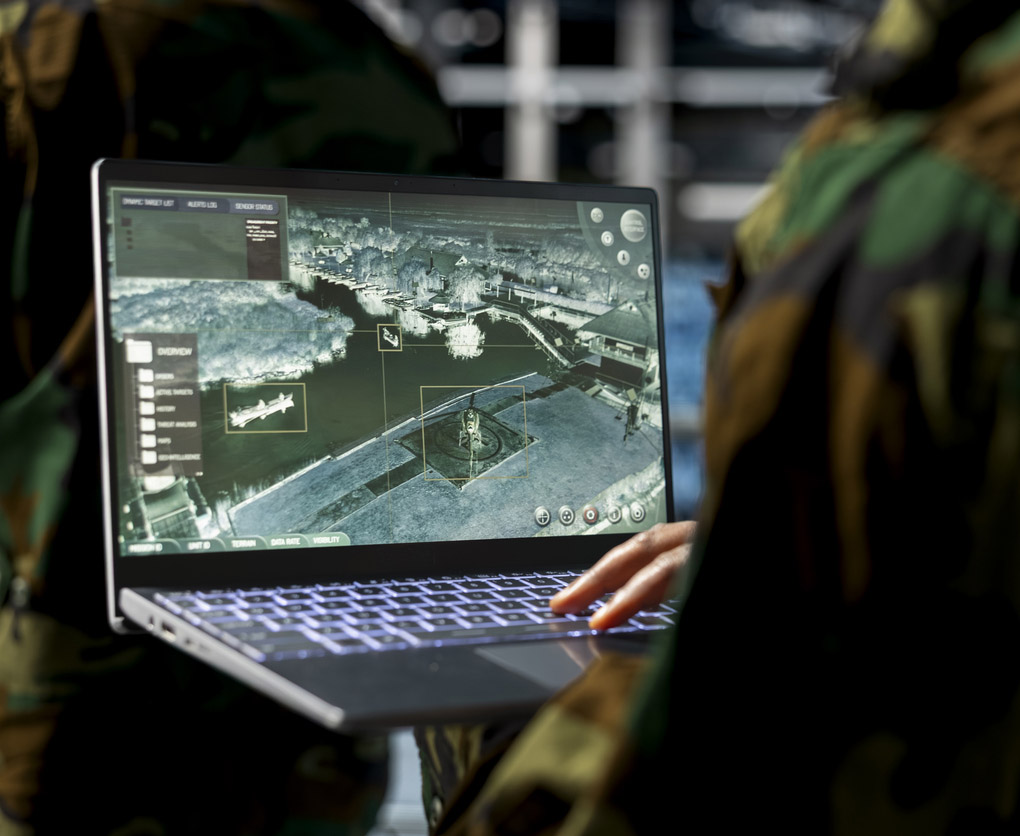
AAU is currently publishing a series of six articles on the development of critical military technologies and how decades of university research made them possible. The first two of six articles cover artificial intelligence and biomanufacturing — with more to come.
University research has led to major scientific discoveries in many fields like public health, technology, advanced manufacturing, agricultural production, and engineering. While discoveries in these areas are better known, many people are less aware of how university research has led to significant advances in our national security. Research in AI, biology, and physics has helped develop key technologies now used to give our U.S. military service members advantages over adversaries.
In 2025, the Department of Defense (DOD) updated its research and development priorities, reducing them from 14 to six main technology areas:
Applied Artificial Intelligence (AAI) – Years of research into combining deep learning models at Stanford and robotics at Carnegie Mellon provided the foundational discoveries that have led to the development of high-speed weapons and targeting tools. These AI systems process data faster and help the military make more rapid and accurate decisions during combat.
Biomanufacturing (BIO) – Researchers at UC Berkeley laid the groundwork for the engineering of DNA, a key technology used in biomanufacturing. This field uses biology and robotics to program microorganisms to make useful materials for troops. One example involves turning algae into Sustainable Aviation Fuel (SAF), which can power military aircraft while reducing the need for traditional fuel sources and increasing our U.S. forces’ self-sufficiency.
Contested Logistics Technologies (LOG) – Research at MIT, and later at Carnegie Mellon, made possible the military’s adoption of autonomous AI-driven logistics technology which help provide a force multiplier by delivering supplies in high-risk environments during combat without involving human personnel. LOG has led to the development of self-driving vehicles that bring food, medicine, and equipment to troops in combat zones while also scanning for threats and planning safer routes.
Quantum and Battlefield Information Dominance (QIB) – To improve navigation, the military has explored the use of quantum sensors, whose development originated from breakthroughs at federal labs, the University of Arizona, and the University of Colorado Boulder. Quantum sensors measure light and atoms to create extremely accurate navigation systems. These tools are replacing GPS, which depends on satellites that can be jammed or hacked during combat.
Scaled Directed Energy (SCADE) – Laser technology, first studied at Columbia University in the 1950s, is now powerful and accurate enough for defense use after further breakthrough discoveries at the University of Rochester. Modern military lasers, like those in the Navy’s HELIOS system, can track and destroy drones or missiles from afar with greater accuracy.
Scaled Hypersonics (SHY) – Hypersonic weapons can travel faster than Mach 5, five times the speed of sound. The U.S. Army’s “Dark Eagle” missile can strike distant targets quickly and adjust its path mid-flight for better accuracy. Foundational research for hypersonics took place at research universities in the 1950’s and 1960’s. Today, solutions that drive hypersonic weapon innovation, have been discovered at specially designed labs, like Purdue University’s Mach 6 quiet wind tunnel.
Learn more about the university research origins that led to each of these six core technologies. Below is a series of six articles which provide further details about how scientific breakthroughs from university research were instrumental in their development.